


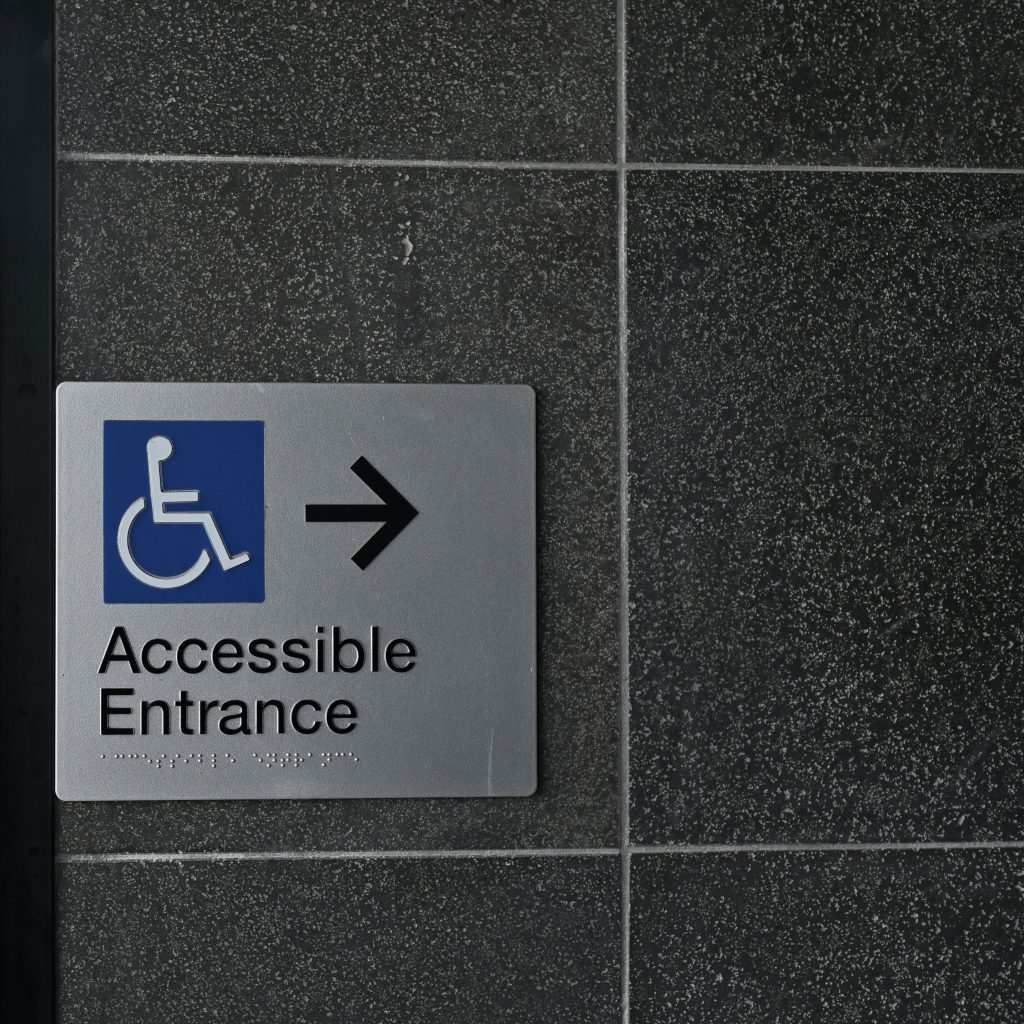





Implementing thoughtful accessible signage is essential for creating inclusive, easy-to-navigate environments across retail, commercial, and public estates. Going far beyond basic regulatory compliance, high-quality accessible signage incorporates tactile Braille, high-contrast visual standards, and intuitive positioning. In this guide, we explore how prioritizing inclusive signage enhances user experience, protects brand reputation, and ensures every visitor navigates your premises with confidence and independence.
Accessible signage ensures all visitors, regardless of ability, can navigate your spaces with ease and independence.
In the UK, around 1 in 5 people have a disability that affects daily living, meaning your signage must be thoughtfully designed to serve a broad range of needs.
Who benefits from inclusive design?
While many still refer to “DDA compliance,” the legal landscape in Great Britain has evolved. The original Disability Discrimination Act (DDA) of 1995 established the foundation for access , but it has since been replaced by the Equality Act 2010.
The “Reasonable Adjustment” Duty The Act places a helpful legal duty on service providers to make “Reasonable Adjustments” to physical features, such as wayfinding, to ensure disabled people are not disadvantaged. Compliance here isn’t just a requirement; it’s a commitment to making your brand accessible to everyone.
Practical Guidance (Approved Document M) To help translate the law into physical signage, we look to Building Regulations: Approved Document M. This provides the blueprint for:
Translating regulatory standards into aesthetic, brand-aligned solutions is where our 130+ years of craft and knowledge come into play. We help you move beyond the legal minimum to create truly inclusive spaces.
The Result: High-quality, inclusive signage that maintains your brand integrity while ensuring every visitor feels welcome from the moment they arrive.
Ready to make your spaces welcome to everyone?
We use cookies to improve your experience on our site. By using our site, you consent to cookies.
Manage your cookie preferences below:
Essential cookies enable basic functions and are necessary for the proper function of the website.
These cookies are needed for adding comments on this website.
Google reCAPTCHA helps protect websites from spam and abuse by verifying user interactions through challenges.
Statistics cookies collect information anonymously. This information helps us understand how visitors use our website.
Google Analytics is a powerful tool that tracks and analyzes website traffic for informed marketing decisions.
Service URL: policies.google.com (opens in a new window)
Clarity is a web analytics service that tracks and reports website traffic.
Service URL: clarity.microsoft.com (opens in a new window)
You can find more information in our Cookie Policy and Privacy Policy.